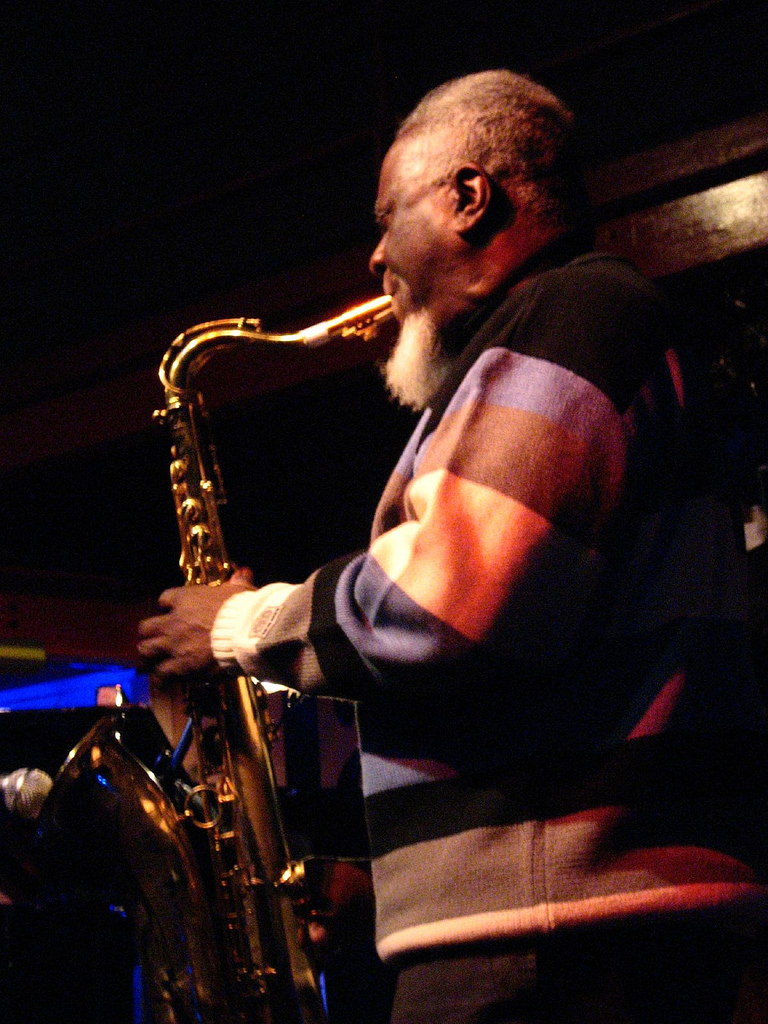
An eleven-part answer to the question "Who is Colin Towns?"

I wrote on Facebook last month about Colin Towns, and a musician responded:
"Who?"
Here is my eleven-part attempt at a definitive answer to nail that question. (Photo credit: Roger Thomas.)
1.Big Band and orchestra composer. Last year Colin was appointed 'composer in residence' by Hamburg's NDR Bigband. Over the past 15 years he has written, arranged, recorded and toured several productions for the NDR. His works being performed far wide as China, New York and Chicago.
For the HR Bigband in Frankfurt, he arranged the music of the Mahavishnu Orchestra featuring Billy Cobham and then orchestrated this music for the Adelaide Symphony Orchestra and an all star electric septet featuring Frank Gambale, Guy Barker and Ernie Watts.. A Cole Porter album with Nils Landgren and the Bohuslän Big Band from Sweden was released on ACT Music earlier this year.
His new multi-media project for NDR Big Band, entitled "Hamburg Harbour Sound and Vision 1925-2011" will premiere at this month's Elbjazz festival in Hamburg Harbour.
2. Film and TV composer. At the age of 27 Colin Towns scored his first feature film, the cult thriller Full Circle/The Haunting of Julia. Mia Farrow agreed to star in the film after hearing Colin's demos. The soundtrack album was among one of Virgin's first 50 releases.
On imdb.com he has 117 credits. In fact he has written scores for in excess of 300 feature films, television dramas and animations. His film credits include Crimson Rivers 2 starring Jean Reno (France), Albert Schweitzer starring Barbara Hershey (Germany) and Vampires Kiss starring Nicolas Cage (USA), Ade Edmondson and Rick Mayall's 1999 feature film Guest House Paradiso "a rare breed of psycho lounge jazz." Television credits includes Cadfael, Our Friends in the North and Doc Martin. He has been nominated both for Ivor Novello and BAFTA awards.
3. Recording Artist. Colin has released over 30 albums. With major contributions to over 20 more.
4. Rock Musician. Whilst in rock band Gillan he co-wrote their album Mr Universe which reached number 11 in the charts. The next two albums for Virgin went straight in at numbers 3 and 2.
5. Ballet Composer. Colin collaborated with world-acclaimed choreographer David Bintley on a new production of Orpheus for the Birmingham Royal Ballet. The Mask Orchestra played for the ballet which toured in 2004 and 2008.
6.Theatre composer. Colin regularly writes for theatre and plays include Hamlet in Chicago, The Royal Hunt of the Sun in Tokyo and several plays in the West End such as Rain Man and The Prisoner of Second Avenue. He also orchestrated the Rod Stewart musical Tonight's the Night.
7. Composer for animations. He has written scores for Angelina Ballerina, The World of Peter Rabbit & Friends, Fungus the Bogeyman and Oi! Get off our Train directed by world renowned director animator Jimmy Murakami with vocals by Norma Winstone.
8. Composer for adverts. Colin has scored several high profile adverts such as Elizabeth Taylor's White Diamonds (USA), General Motors (USA), Elizabeth Arden (USA). Budweiser was launched in the UK with three commercials and one featured a talking not playing Oscar Peterson. When listening to the playback on set he immediately said "that's John Taylor on piano isn't it" and of course it was.
9. Song composer. Artists that have covered his songs include Roger Daltry and Dusty Springfield.
10. Record Company Owner/Producer. He is the owner of Provocateur Records. The label has made a special contribution to furthering the cause of British jazz, having released albums featuring artists such as Mike Gibbs, Andy Sheppard, Ralph Towner, Steve Swallow, Guy Barker, Alan Skidmore and Norma Winstone.
11. Bandleader of small and large bands. Towns is due to launch his new small group in Germany later this month: Blue Touch Paper will feature Mark Lockheart and Chris Montague. Towns has described the music of Blue Touch Paper: "Challenging, electronic, looking forward. It can be anything you want it: it can be madly exciting because I've got a reputation for writing things which sometimes are unplayable - which is not untrue - as well as using space and melody."
Colin Towns directs the 18-piece Mask Orchestra. John L Walters gave their last London appearance - photo above - 5 stars and described "a steaming cauldron of sound that churned Mahavishnu Orchestra, Mike Gibbs and Gil Evans[..] Stunning."
The CD "In My Own Write," reviewed by Chris Parker here, is this week's prize draw for newsletter readers.
Cheltenham Jazz Festival Round-up: Saturday
Cheltenham Round-Up by Tom Gray (John Taylor and Julian Arguelles, Spin Marvel and John Paul Jones, Pharaoh Sanders, Django Bates and the TDE's)
(Various venues in Cheltenham, 30th April 2011)
In the first of our three reports from Cheltenham 2011, Tom Gray reports on the Saturday of the festival:
By noon of the third day of this year’s Cheltenham Jazz Festival, a sizeable crowd had already gathered in the spring sunshine of the Imperial Gardens, nursing Royal Wedding hangovers to the strains of a varied and vibrant fringe festival programme on the free stage. It is encouraging to see that the festival now has such prominence in the annual life of the town. However, perhaps the most reliable health-check of a festival is in the size of the paying audience, and I am happy to report sell-out or near sell-out audiences at all four of the concerts I attended.
In the Town Hall’s Pillar Room, John Taylor and Julian Argüelles kicked off the afternoon’s entertainment in sublime fashion. Their musical camaraderie goes back over two decades and their ability to step inside each other’s way of thinking was clear throughout. Even when peering through his specs at a couple of new compositions from Arguelles, Taylor instantly assimilated the material and embellished it with his sophisticated harmonic vocabulary. In addition to some classics from the Taylor and Arguelles catalogue (including ‘Ambleside’ and ‘Phaedrus’), a highlight of the set was a gospel-drenched arrangement of ‘In the Bleak Midwinter’. This duet really swung, albeit in a very folk-inflected, British sort of way. The concert will be broadcast on Radio 3’s Jazz Line-Up in July, while Taylor’s new trio album on Cam Jazz, ‘Requiem for a Dreamer’, features Arguelles and promises great things on the basis of this concert.
Led Zeppelin bass player John Paul Jones was the big-name draw in Martin France’s Spin Marvel, playing in the Jazz Arena tent. However, any casual punters in search of Zep-style riffs and knockout hooks may not have got what they were expecting here. These extended jams incorporated freeform ruminations, glacial electronic soundscapes and bustling cutting edge beats showcasing France’s considerable talents. The set had plenty of absorbing moments including the atmospheric contributions of Norwegians Terje Evensen on laptop and the inimitable Nils Petter Molvaer on trumpet. John Parricelli evoked Silent Way-era John McLaughlin on guitar and provided the most substantial melodic content. But compared to similar projects such as Food and Presenz, the music sometimes lacked shape and direction, and didn't always hold the attention.
Pharaoh Sanders shuffled on to the Town Hall main stage, making an arresting visual impact in a gold lamé kaftan with an immaculately gleaming tenor saxophone to match. Sanders may have made his name playing on some of John Coltrane’s late-period albums, but this set appeared to be a homage to the earlier work of his former employer, including ‘Giant Steps’ and ‘Naima’. Initially Sanders seemed ill at ease with the cavernous sound in the town hall, and he depended heavily on his fine pick-up rhythm section (Jonathan Gee on piano, Mark Hodgson on bass and Gene Calderazzo on drums) to drive the first three numbers, making minimal and rather brittle solo contributions.
On ‘My Favourite Things’, however, something clicked. Inspired by the trance-like groove set up by his rhythm section (channelling the spirit of the McCoy Tyner- Jimmy Garrison-Elvin Jones unit), Sanders opened up to produce some playing of ethereal beauty, alternating between wispy smoke rings of phrases and occasional multiphonic blasts, which challenged even the robustness of the Town Hall’s marble pillars. At times his playing brought to mind a more spacious version of Joe Henderson’s. He followed this up with some characterful ballad playing on ‘A Nightingale Sang in Berkeley Square’, where Gee also impressed with a lyrical, expansive solo. After an uncertain start he had won round the capacity Town Hall audience, many of whom I’m sure, like me, will now make a beeline toward his recorded work.
There was a palpable air of excitement back in the Pillar Room in anticipation of Django Bates’s late evening set which featured a new suite from him, commissioned by Jazz on 3. It was indeed a tantalising and intriguing prospect, with an octet (‘The T.D.E.s’) hand-picked and conducted by Bates that united some of the different camps of rising and recently risen stars in UK Jazz: Troyka’s Chris Montague (guitar), Kit Downes (keyboards), and Josh Blackmore (drums) were joined by Jasper Høiby (unusually on electric bass) to form the band’s powerful rhythmic nucleus while Shabaka Hutchings (alto sax), Jay Phelps (trumpet), Denys Baptiste (tenor sax) and James Allsopp (baritone sax and bass clarinet) made up a stellar horn section.
The quality of the writing and the playing more than lived up to expectations. Much of the suite had a stuttering M-base feel, with time signatures you’d need a degree in mathematics to fully get your head around, but which nevertheless packed a visceral punch with some assured, fired-up improvisation from all of the horn players. The title of one of the pieces, ‘We Are Not Lost, We Are Simply Finding Our Way’, summed it up aptly, as the players took obvious delight in navigating this dislocated funk chart, its metre pulled every which way. This was how I imagine Loose Tubes in their prime would have sounded live. I am sure most of the audience will look forward to re-examining this music when it is broadcast next Monday, as there was so much detail to process on a first listen.
Earlier in the set, Bates reminded us of his versatility as a musician with a typically quirky, romantic set of solo originals. One of the pieces, ‘J.T.’, was dedicated to John Taylor and sounded like it was loosely based on Taylor’s composition ‘Ambleside’. Later on, during the T.D.E.s’ set, Taylor could be seen returning the compliment, watching on appreciatively from the wings. It was a special moment, the type of thing that happens at a festival with programing of this quality.
Cheltenham Jazz Festival website
The Basics of DJ Mixing (Part 2)
Spin an album on turntable A and bring up the volume on channel A. The cross fader is all the way to the left. Now, while it's playing through the speaker system to the audience, cue up a track on turntable B through your headphones. Remember, the cross fader is all the way to the left side, but your headphone toggle switch is all the way to the right. Keep in mind that on a turntable, a cue must be back tracked enough from the desired start point so that the DJ device is up to speed by the time it reaches that point after the "on" switch is engaged. Before starting the turntable, using fingers directly on the label of the record, spin the disk back and forth until you've found your beginning note, then you turn the record backwards far enough from that note so that when you hit the "on" switch the record will be spinning at full speed.
Now as your song on table A comes to an end, switch on turntable B while bringing the cross fader to the center and on toward the right as song B begins to play. You can time this so that A jumps into B or a smooth cross fade takes place, much like the lapse dissolve in film where two images linger together before transitioning away from one to the other. Now that you've faded from table A, you can delete that record and cue up another, reversing the process you just completed.
Another good technique of cross fading involves beat matching and takes more and more practice to accomplish. Listen to both the live track and the cue track through your headphones, playing both tracks at speed. By varying the speed of the turntable you can get the best beats to match up. When you've got both thumping together you cross fade and the songs seem to merge. Then you have scratching, and mash ups and all kinds of remixing techniques and devices, but practice the basic things first and you'll be on your way. Improve your ability! Sure, one day you can be a professional DJ player. Learn more about DJ mixing using video tutorials.
Subscribe to:
Posts (Atom)